Smallpox has had a major impact on world history, not least because indigenous populations of regions where smallpox was non-native, such as the Americas and Australia, were rapidly decimated and weakened by smallpox (along with other introduced diseases) during periods of initial foreign contact, which helped pave theKeeping this in view, how did smallpox changed history?
By the beginning of the 18th century, 400,000 Europeans annually and one out of every seven Russian children were dying of smallpox, a disease that had now been killing unhindered for at least 2,800 years. Further testing proved conclusively that the cowpox virus was able to build immunity against smallpox.
Subsequently, question is, how did smallpox affect the economy? A $300 million effort succeeded in completely eradicating smallpox in less than ten years. Smallpox eradication had limited economic consequences but has left much of world's population highly susceptible to zoonotic orthopoxviruses and to the use of smallpox as a biologic weapon. The primary threat of M.
Beside this, how did smallpox affect people?
The variola virus is the only known cause of smallpox. The disease affects only humans. From there, the virus invades the bloodstream and spreads to the skin, intestines, lungs, kidneys, and brain. The virus activity in the skin cells creates a rash that starts as macules (flat, red lesions).
How was smallpox created?
The origin of smallpox is unknown. The earliest evidence of the disease dates to the 3rd century BCE in Egyptian mummies. The disease historically occurred in outbreaks. Smallpox is one of two infectious diseases to have been eradicated, the other being rinderpest in 2011.
When did they stop vaccinating for smallpox?
1972
Who brought smallpox to America?
Epidemics in the Americas. Smallpox kills millions of native inhabitants of Mexico. Unintentionally introduced at Veracruz with the arrival of Panfilo de Narvaez on April 23, 1520 and was credited with the victory of Cortes over the Aztec empire at Tenochtitlan (present-day Mexico City) in 1521.When did they start vaccinating for smallpox?
1796
Why is smallpox so deadly?
One of the reasons smallpox was so dangerous and deadly is because it's an airborne disease. Airborne diseases tend to spread fast. Coughing, sneezing, or direct contact with any bodily fluids could spread the smallpox virus. In addition, sharing contaminated clothing or bedding could lead to infection.Who is most susceptible to smallpox?
Susceptibility and resistance to smallpox (variola)Pregnant women and people who are immunocompromised are more susceptible to variant forms of smallpox. It is unclear how long the smallpox vaccine provides effective immunity, but it is unlikely to be more than 10 years.How was smallpox treated in the past?
One of the first methods for controlling the spread of smallpox was the use of variolation. Named after the virus that causes smallpox (variola virus), variolation is the process by which material from smallpox sores (pustules) was given to people who had never had smallpox.What countries were affected by smallpox?
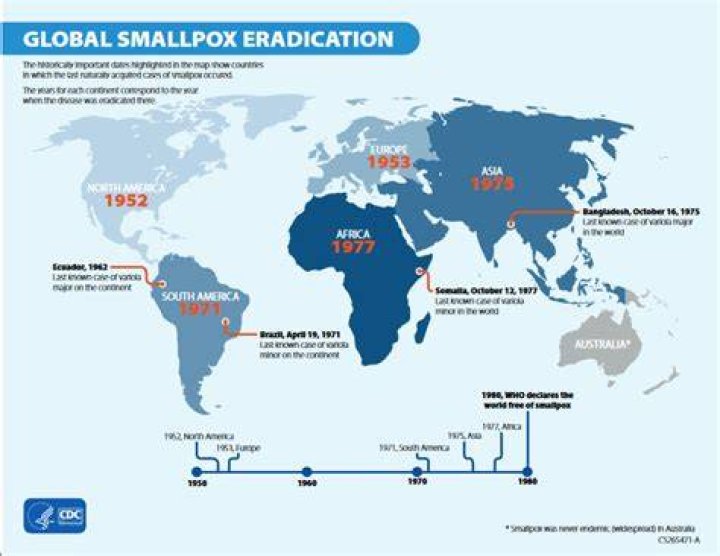
Since October 16, 1975 -- more than 2 years ago -- when a case occurred in Bangladesh, smallpox has been detected only in Ethiopia, Kenya, and Somalia, 3 countries which together with Djibouti are linked by the Ogaden Desert to form one epidemiologic unit.Is smallpox still around today?
Currently, there is no evidence of naturally occurring smallpox transmission anywhere in the world. Although a worldwide immunization program eradicated smallpox disease decades ago, small quantities of smallpox virus officially still exist in two research laboratories in Atlanta, Georgia, and in Russia.How can you prevent smallpox?
Smallpox can be prevented by the smallpox vaccine. If you get the vaccine: Before contact with the virus, the vaccine can protect you from getting sick. Within 3 days of being exposed to the virus, the vaccine might protect you from getting the disease.What did people believe caused smallpox?
Smallpox is believed to have first infected humans around the time of the earliest agricultural settlements some 12,000 years ago. By that time, the contagious disease, caused by the variola virus, had spread all across Africa and Asia as well, prompting some cultures to worship special smallpox deities.How many people died from Ebola?
The impact this epidemic had on the world, and particularly West Africa, is significant. A total of 28,616 cases of EVD and 11,310 deaths were reported in Guinea, Liberia, and Sierra Leone. There were an additional 36 cases and 15 deaths that occurred when the outbreak spread outside of these three countries.How many died from smallpox?
The scourge of the worldAn estimated 300 million people died from smallpox in the 20th century alone. This virulent disease, which kills a third of those it infects, is known to have co-existed with human beings for thousands of years.What disease have been eradicated?
Two infectious diseases have successfully been eradicated: smallpox and rinderpest. There are also four ongoing programs, targeting poliomyelitis, yaws, dracunculiasis, and malaria.How long did it take to eradicate smallpox?
The last known natural case was in Somalia in 1977. Since then, the only known cases were caused by a laboratory accident in 1978 in Birmingham, England, which killed one person and caused a limited outbreak. Smallpox was officially declared eradicated in 1979.How much did it cost to eradicate smallpox?
Costs of smallpox and its eradicationNonetheless, the Intensified Smallpox Eradication Program has been estimated to have cost $300 million in total from 1967 to 1977 31 with one-third of the funding provided by international donors and the remaining two-thirds financed by endemic country governments.Why is it called smallpox?
Smallpox is a serious, contagious, and sometimes fatal infectious disease caused by a virus called the variola virus. The disease gets its name from the Latin word for “spotted” and refers to the small pus-filled blisters that appear on the face and body of an infected person.Did smallpox come from cows?
Cowpox, also called vaccinia, mildly eruptive disease of cows that when transmitted to otherwise healthy humans produces immunity to smallpox. The cowpox virus is closely related to variola, the causative virus of smallpox.