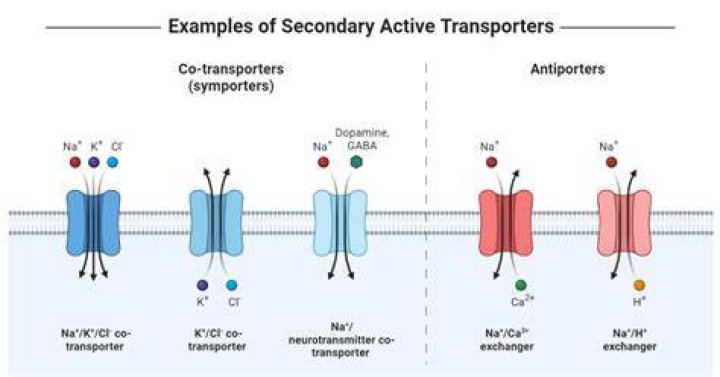
Correspondingly, what are the types of secondary active transport?
Two types of secondary active transport processes exist: cotransport (also known as symport) and exchange (also known as antiport).
Similarly, does secondary transport require ATP? Secondary active transport , created by primary active transport, is the transport of a solute in the direction of its electrochemical gradient and does not directly require ATP.
Herein, what is primary and secondary active transport?
Primary and Secondary Active Transport. In primary active transport, the energy is derived directly from the breakdown of ATP. In the secondary active transport, the energy is derived secondarily from energy that has been stored in the form of ionic concentration differences between the two sides of a membrane.
Is endocytosis secondary active transport?
Endocytosis. Endocytosis is a type of active transport that moves particles, such as large molecules, parts of cells, and even whole cells, into a cell. The particles bind to the proteins and the plasma membrane invaginates, bringing the substance and the proteins into the cell.
What are 4 types of active transport?
Active Transport. Active Transport is the term used to describe the processes of moving materials through the cell membrane that requires the use of energy. There are three main types of Active Transport: The Sodium-Potassium pump, Exocytosis, and Endocytosis.What are examples of secondary active transport?
An example of secondary active transport is the movement of glucose in the proximal convoluted tubule.Why is secondary active transport?
Secondary active transportThe electrochemical gradients set up by primary active transport store energy, which can be released as the ions move back down their gradients. Secondary active transport uses the energy stored in these gradients to move other substances against their own gradients.What is active and passive transport?
Active transport is the movement of molecules or ions against a concentration gradient (from an area of lower to higher concentration), which does not ordinarily occur, so enzymes and energy are required. Passive transport is the movement of molecules or ions from an area of higher to lower concentration.What is a vesicle transport?
Transport vesicles can move molecules between locations inside the cell, e.g., proteins from the rough endoplasmic reticulum to the Golgi apparatus. Membrane-bound and secreted proteins are made on ribosomes found in the rough endoplasmic reticulum. These proteins travel within the cell inside of transport vesicles.Is facilitated diffusion active or passive?
Facilitated diffusion (also known as facilitated transport or passive-mediated transport) is the process of spontaneous passive transport (as opposed to active transport) of molecules or ions across a biological membrane via specific transmembrane integral proteins.What is the difference between exocytosis and endocytosis?
Endocytosis is the process of capturing a substance or particle from outside the cell by engulfing it with the cell membrane, and bringing it into the cell. Exocytosis describes the process of vesicles fusing with the plasma membrane and releasing their contents to the outside of the cell.Is phagocytosis active or passive?
Cards
| Term movement of molecules from areas of high concentration to areas of low concentration | Definition diffusion |
|---|---|
| Term pinocytosis; active or passive transport | Definition active transport |
| Term phagocytosis | Definition taking molecules into cell |
| Term phagocytosis; active or passive transport | Definition active transport |
What are the two main types of active transport?
There are two main types of active transport:- Primary (direct) active transport – Involves the direct use of metabolic energy (e.g. ATP hydrolysis) to mediate transport.
- Secondary (indirect) active transport – Involves coupling the molecule with another moving along an electrochemical gradient.
