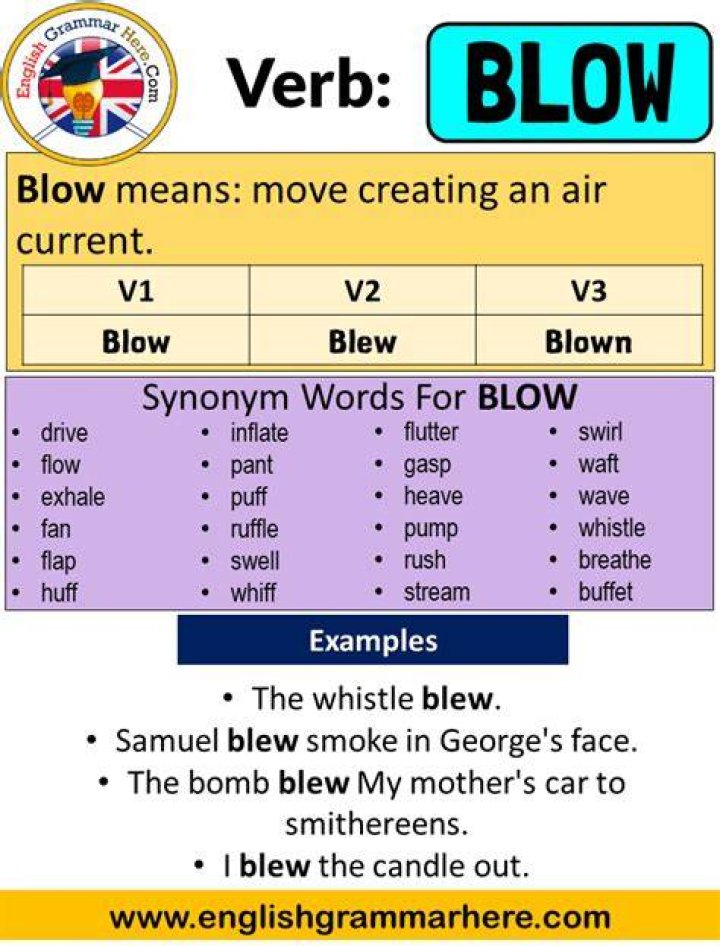
Beside this, what is the second form of blow?
What is Verb first / (2nd) second form of Blow (Past) and (3rd) third form of Blow (Past Participle) in English grammar. See above verb Blow Second form and Blow Third forms [Blew] [Blown].
Beside above, is it blowed or blew? verb blows, blowing, blew or blown past participle blowed informal another word for damn I'll be blowed; blow it!
Keeping this in consideration, what is the third form of blow?
Conjugation of 'Blow'
| Base Form (Infinitive): | Blow |
|---|---|
| Past Simple: | Blew |
| Past Participle: | Blown |
| 3rd Person Singular: | Blows |
| Present Participle/Gerund: | Blowing |
What is the perfect tense of blow?
Blow Past Tense. past tense of blow is blew.
Is blew past tense?
The past tense of blow is blew. The past participle of blow is blown.Is blew an irregular verb?
Below is our common English irregular verbs list which includes 213 verbs and shows the infinitive, the past simple and the past participle forms. Alternate forms are separated by a / character.
Search:
| Base Form | Past Simple | Past Participle |
|---|---|---|
| Bite | Bit | Bitten |
| Bleed | Bled | Bled |
| Blow | Blew | Blown |
| Break | Broke | Broken |
Is driving a gerund?
Gerund: Driving is fun.Here the phrase “driving home” modifies Kate and Here “driving” is acting as the is acting as an adjective, not a noun, thus making it a subject (noun) of the sentence, participle and not a gerund. thus making it a gerund and not a participle.What is the past participle of fly?
Flown
What does blowed mean in slang?
blowed. blowed. adjective. Blowed is defined as a person experiencing confusion or amazement. An example of blowed used as an adjective is in the sentence, "Well, I'll be blowed," which means "Well, I'm amazed."What is past tense of cut?
The past tense of cut is also cut. The third-person singular simple present indicative form of cut is cuts. The present participle of cut is cutting. The past participle of cut is cut.What is mean by blew?
The definition of blew is the past tense of to blow, meaning you pushed something using air from your mouth or something like wind pushed something forcefully.What is the past participle of lose?
The past tense of lose is lost. The third-person singular simple present indicative form of lose is loses. The present participle of lose is losing. The past participle of lose is lost.How do you use blew in a sentence?
blew Sentence Examples- She grabbed a tissue from the box on the counter and blew her nose.
- She wiped her eyes and blew her nose.
- She blew out a breath.
- Everything almost blew up a few months ago.
- The snow started shortly after they left and the wind blew it horizontal.
- I blew my chance and now I may have destroyed yours.
What is the future tense of blow?
Explore topics
| Simple Form | |
|---|---|
| Present | |
| Future | |
| I, you, he, she, it, we, they | will blow |
| Future perfect | |
Can past tense?
Could is used as the past tense of "can".What do you mean by past participle?
Definition of past participle. : a participle that typically expresses completed action, that is traditionally one of the principal parts of the verb, and that is traditionally used in English in the formation of perfect tenses in the active voice and of all tenses in the passive voice.Is blew a transitive verb?
(transitive) If you blow something, you do not do it successfully. I can't believe it. You almost had it, but you blew it. (transitive) If you blow money, you spend it, often without being careful.What is the past tense of grow?
The past tense of grow is grew. The third-person singular simple present indicative form of grow is grows. The present participle of grow is growing.What is the present tense of spoken?
Grammatically speaking , SPOKEN is used in the present perfect tense form. The verb SPOKEN is a past participle form of lexical verb SPEAK. It's past form is spoke.What is the past tense of teach?
taught
